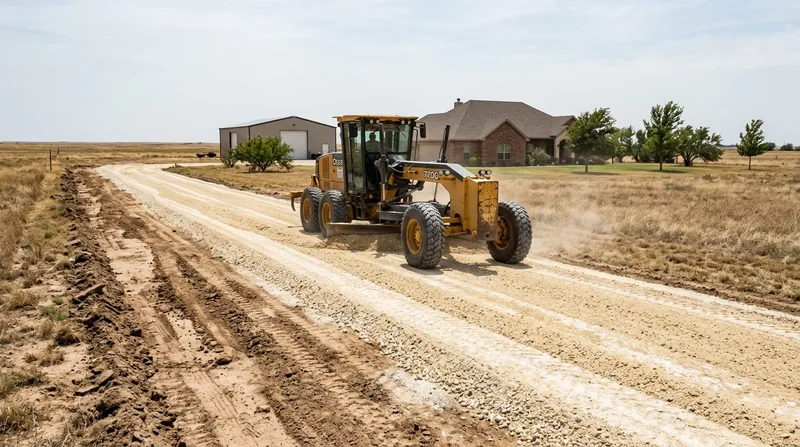




Gravel driveways across the Texas Panhandle face a unique challenge: the flat Llano Estacado's Pullman clay loam, constant wind, spring cloudbursts, and freeze-thaw winters turn unprepared lanes into washboards and potholes within months. Whether you own a ranch outside Amarillo, a home in the Colonies or Heritage Hills, or manage a private road in Canyon or Bushland, gravel driveway installation and grading built on proper base layers and correct crown is the difference between a drive that lasts three years and one that holds up through a decade of West Texas weather. We build gravel drives in proper lifts of caliche and crushed flex base over geotextile fabric, and we regrade washed-out lanes and fill potholes that summer storms carve into existing gravel surfaces. Good grading is also the foundation for every future asphalt project, so getting the base right the first time saves money down the road. Amarillo Asphalt Paving has handled gravel driveway work across Amarillo, Panhandle, Bushland, Canyon, Hereford, and the surrounding Panhandle since 2011. Call us at (806) 513-4920 for a free written estimate and tonnage specifications, or read on to understand how gravel drives work on caliche ground and what goes into a job that will not wash away.
Why Gravel Driveway Installation and Grading Matter on the Panhandle
The Panhandle's clay loam sits over caliche caprock, and that caprock sheds water like a roof. Summer cloudbursts and winter melt concentrate runoff into every low spot, and without proper crown and base preparation, a gravel drive becomes a network of ruts and standing water within the first wet season. Cattle ranches, wheat farms, and hobby properties beyond town rely entirely on gravel lanes because asphalt season is short and the cost per mile climbs fast. Even in town, where HOA rules or budget constraints keep a driveway gravel, the right installation and regular grading maintenance mean the difference between a usable surface and a muddy, potholed mess.
- We build new gravel drives with caliche base and crushed flex base in proper lifts, compacted and crowned to shed water toward the shoulders.
- We regrade existing gravel lanes, filling washboard ruts, potholes, and low spots that trap water and damage the surface.
- We install geotextile fabric beneath the base to separate subgrade from stone and slow subsurface water migration that weakens the caprock.
- We set the crown correctly so rain runs off the center line instead of pooling in the middle or along the edges.
- We handle the caliche and clay ground that dominates the Panhandle, building a stable base that does not shift or settle under truck weight.
A properly graded and prepared gravel drive can serve a ranch entrance, a rural home, or a private road for years without major repair, and it lays the exact foundation that an asphalt overlay or full paving job will need later.
Key info: The Panhandle's freeze-thaw cycle and spring runoff are the main enemies of gravel drives. A drive built on bare caliche or clay without proper base and crown will fail in two to three years. Correct preparation on the caliche caprock that underlies Amarillo, Canyon, Bushland, and the surrounding ranches means your gravel drive will handle ten years of weather and heavy use.
For context on how gravel fits into the broader range of driveway surfaces and when to consider asphalt driveway paving instead, see our full service menu.
How We Install and Grade Gravel Driveways in Amarillo and the Panhandle
A gravel driveway job starts with a site visit to assess subgrade, drainage, and the caliche or clay foundation beneath. We then excavate to the proper depth, remove any soft or saturated soil, and build the base in layers. Each layer is compacted before the next is added, so the final drive sits on a stable, well-draining platform that will not settle or shift under a truck or tractor. Grading work on existing drives follows the same logic, but focuses on reworking the surface and shoulders to restore crown and fill washouts.
- We excavate to subgrade and remove soft, saturated, or unsuitable material down to stable caliche or clay.
- We lay geotextile fabric over the prepared subgrade to separate it from the stone base and reduce water migration into the caprock.
- We place and compact the first lift of caliche or crushed limestone base, typically four to six inches, in two or three passes with a compactor.
- We place and compact the second lift of crushed flex base or crusher run, another four to six inches, creating a dense, well-draining layer.
- We finish with a top layer of gravel or recycled asphalt millings, properly crowned, so water runs off the center line toward the shoulders.
- We proof-roll the finished drive with a loaded truck to verify compaction and surface stability.
The entire process takes a day or two depending on the length and width of the drive and the condition of the subgrade. Once finished, the drive is ready to use immediately and will remain stable and passable for years with routine grading.
Example: A ranch entrance outside Hereford with a quarter-mile caliche drive that had washed into ruts and low spots after three years of summer storms. We excavated the soft spots, reset the crown, and added a new top layer of recycled asphalt millings. The drive now sheds water correctly and will handle another five to seven years of use before it needs regrading.
If you are considering whether to maintain your gravel drive or move to a paved surface, driveway repair and grading are the first step; asphalt resurfacing or overlay becomes the next conversation if you want a permanent solution.
Gravel Driveway Installation and Grading Methods
| Approach | Description | Best for |
|---|---|---|
| New Gravel Drive on Caliche | Excavate to stable caliche, lay geotextile, add caliche base and crushed flex base in compacted lifts, finish with gravel top course, crown for drainage. | Ranch entrances, rural properties, and private roads where the subgrade is caliche or stable clay. |
| Regrading and Washout Repair | Blade and recompact existing gravel surface, restore crown, fill potholes and low spots, add fresh gravel or millings as needed. | Existing gravel drives that have settled, rutted, or washed out after heavy rain or years of use. |
| Geotextile and Base Preparation | Install geotextile fabric over subgrade before any stone base, reducing water infiltration and extending the life of the caliche or clay foundation. | New drives on soft or wet subgrade, or in areas with high seasonal water table or spring runoff. |
| Recycled Asphalt Millings Top Course | Build the caliche and flex base as above, then finish with recycled asphalt millings instead of stone gravel, which compacts and hardens over time. | Driveways where a slightly harder, more stable surface than loose gravel is desired, but full asphalt paving is not yet needed. |
| Grading and Maintenance | Annual or bi-annual blading and recompacting of existing gravel drives to maintain crown, fill ruts, and keep the surface passable. | Existing drives that are in fair condition but need regular upkeep to prevent major washout or pothole damage. |
Gravel Driveway Installation and Grading Cost in Amarillo: What to Expect
Gravel driveway installation and grading pricing depends on the length and width of the drive, the condition of the subgrade, the depth of excavation required, and whether you need new base preparation or are regrading an existing surface. A new gravel drive on stable caliche with proper base and crown typically starts at $950 for a short ranch entrance or residential drive, but a longer lane or one that requires extensive subgrade work will cost more. A full pricing overview with detailed ranges is available on our pricing page.
The single largest variable is the length of the drive and the volume of material needed. A 100-foot residential driveway may require two to four tons of caliche base and flex base plus a ton or two of gravel top course. A quarter-mile ranch entrance can run ten to fifteen tons or more. We provide written estimates with tonnage specifications so you know exactly what material is going into the job and can compare our bid fairly against others.
Regrading an existing gravel drive costs less than building new because the subgrade is already there and stable. A washout repair or crown restoration on a drive that is in fair condition may run $500 to $1,200 depending on the extent of the work. A full renovation of a badly rutted or potholed drive, with new base layers and top course, can approach the cost of new construction.
We do not charge a separate travel or call-out fee in Amarillo and the surrounding Panhandle. The estimate is free and comes with written tonnage specifications. Call (806) 513-4920 to schedule an on-site look, and we will provide a firm bid within 24 hours.
Gravel Driveway Installation and Grading Near Me: What Amarillo Homeowners Should Know When Hiring a Contractor
When you hire a contractor for gravel driveway work in Amarillo, Bushland, Canyon, or anywhere in the Panhandle, there are a few key things to verify. First, make sure the contractor is fully insured and can provide a certificate of insurance on request. Second, get multiple written estimates, each with tonnage and material specifications so you can compare apples to apples. Third, ask for references from recent jobs in your area, and call them to confirm the work was done on time and to the customer's satisfaction. Fourth, if your driveway borders a right-of-way or if your property is in an HOA, check with your local municipality or HOA to see if a permit or approval is required before work begins. Texas law requires a utility locate (call 811 before you dig) before any excavation, and your contractor should handle that as a matter of course.
- Verify that the contractor carries full liability and property damage insurance and can provide a current certificate.
- Ask for written estimates from at least two or three contractors, each with tonnage, material type, and scope clearly spelled out.
- Call references from jobs done in the last year in Amarillo or nearby towns to confirm quality, timeliness, and customer satisfaction.
- Check with your city or county building department to learn whether a permit is required for driveway work or right-of-way cuts.
- If you live in an HOA community like Heritage Hills, Greenways, or Town Square, review your architectural guidelines to confirm that gravel or the proposed material is permitted.
- Confirm that the contractor will call 811 for a utility locate before any digging begins, as required by Texas law.
A contractor who provides a written estimate with tonnage specs, carries insurance, and checks references is doing the work right. If a contractor shows up unsolicited, offers a discount for cash, or cannot provide insurance or references, move on. For a free estimate and to discuss your specific gravel driveway or grading project, contact us or call (806) 513-4920.
Gravel Driveway Installation & Grading in Amarillo: Pricing Guide
| Service | Price | Details |
|---|---|---|
| Short residential gravel driveway (100-150 feet) | Starting at $950 | Includes caliche base, flex base, and gravel top course with proper crown and compaction on stable subgrade |
| Regrading and washout repair (existing drive) | Starting at $600 | Blade, recompact, restore crown, and add fresh gravel or millings to repair rutting and low spots on existing surface |
| Ranch entrance or longer lane (250+ feet) | Starting at $1,800 | Excavation, geotextile, caliche and flex base lifts, and gravel finish; price scales with length, width, and subgrade condition |
| Recycled asphalt millings top course upgrade | Add $200-400 | Substitute recycled asphalt millings for loose gravel top course to create a harder, more stable surface that compacts over time |
| Utility locate and permit coordination | Included | Texas 811 utility locate call and coordination with local permitting; no separate fee charged to homeowner |
| Free written estimate with tonnage specs | Free | On-site visit, measurement, material and tonnage breakdown, and firm bid; no obligation to book; response within 24 hours |
Indicative pricing, the exact cost depends on square footage, finish, and site access. Free personalized estimate within 24h at (806) 513-4920.


